STREET EXPERIMENTS AFRICA

This is a Young Urbanists Project

STREET EXPERIMENTS AFRICA

New ways to make streets safer

Cape Town

Tactical Urbanism
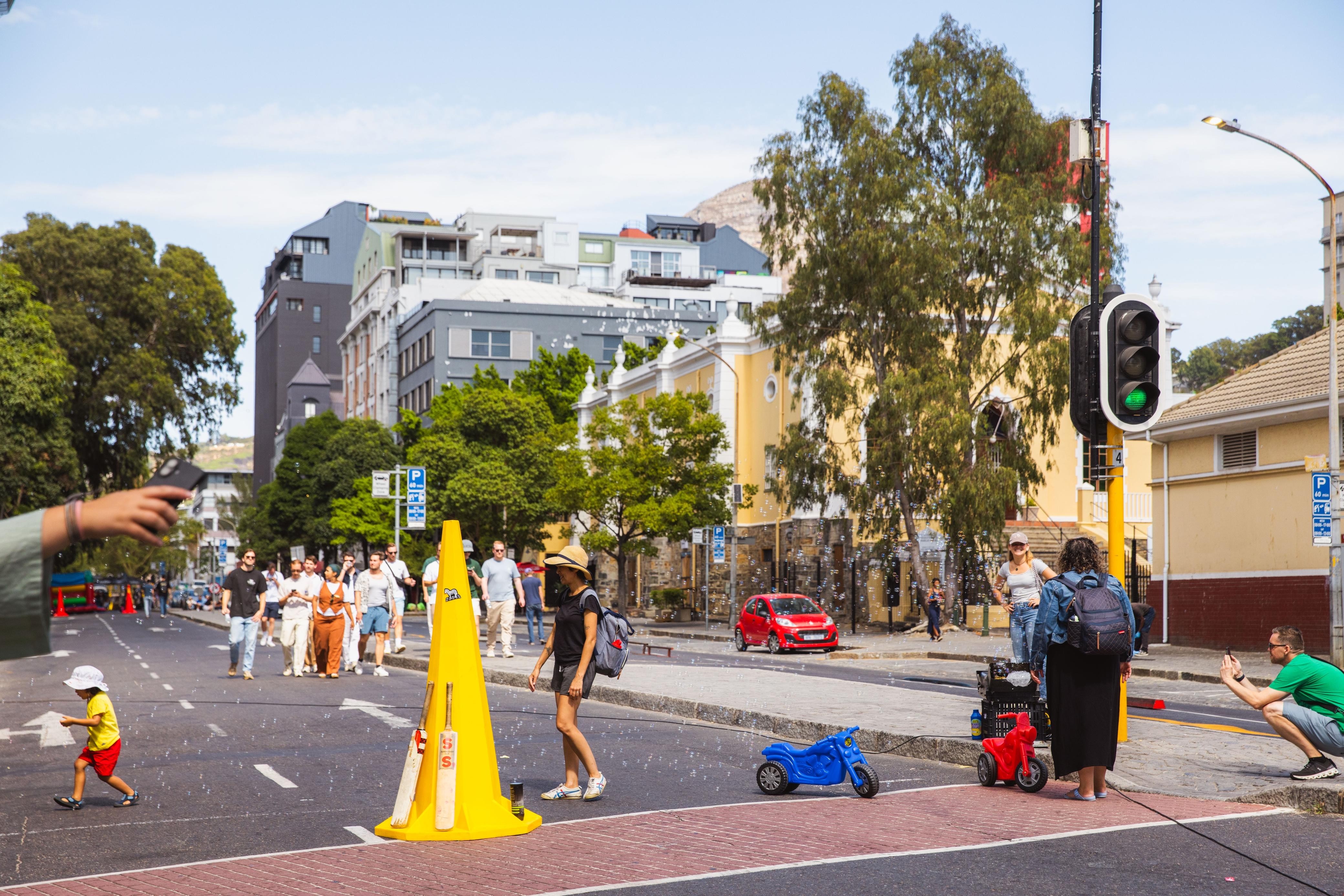
Street experiments are temporary, low-cost interventions that explore new ways of using streets and public spaces. They aim to make streets safer, more inclusive, and vibrant by reimagining their design using tactical bollards, yellow cones, barriers, removable concrete curbs, and other tools to redefine street layouts. These experiments often involve temporarily closing streets to cars, narrowing roads, adding pop-up bike lanes, or transforming large intersections into protected areas or shared spaces for pedestrians and other uses.

The purpose of street experiments is to demonstrate what’s possible. They offer opportunities to test ideas in real-time, gather feedback from the community, and evaluate the impact of changes before committing to permanent redesigns. By encouraging participation and producing tangible results, street experiments can shift how people perceive urban spaces and build public support for long-term improvements. They also provide communities, officials, and councillors with better tools to assess what works and what doesn’t.

There are two types of street experiments we aim to introduce across local governments in South Africa. The first involves temporarily closing a street on a weekly or monthly basis without needing an events permit, allowing communities to test new ideas. The second is more aligned with everyday urbanism, where intersections are closed or roads are “dieted” daily to gather real-time feedback. This approach is similar to how the City of Cape Town and SANRAL use tactical bollards to influence driver behaviour—but in our case, these tools are used to protect pedestrians, vulnerable road users and support other non-vehicular uses.

In Cape Town, the Bree Street Sunday Experiment is our example of the first type. From October 27, 2024, until March 2025, Bree Street has been closed to vehicles every Sunday, transforming into a car-free space where pedestrians and cyclists take centre stage. Notably, this initiative did not require a formal events permit, as it was classified as a non-event by the City. This significantly reduced the costs of implementation, allowing us to carry out the weekly experiment along Bree Street—from Wale to Strand—and including Shortmarket Street between Bree and Long, for a six-month period.

Supported by the City of Cape Town and Mayor Geordin Hill-Lewis, the experiment offered a unique opportunity to reimagine one of the city's most iconic streets as a space for people rather than vehicles. It was not designed as a commercial or entertainment event, but as a calm, inclusive environment where everyone could feel welcome. Our street ambassadors, the Green Riders, served as marshals, while we activated the space with support from local businesses, communities, our networks, and friends from afar—all in line with the non-event nature of the programme.

This project forms part of our Safer Streets Programme, which seeks to connect all road safety stakeholders and demonstrate scalable solutions for other areas in the country. Through ongoing collaboration with residents, businesses, and participants, the Bree Street Experiment evolved each week—offering valuable insights and inspiration for future street design. The initiative is also aligned with the CBD’s Local Spatial Development Framework (LSDF), which includes a Mobility and Accessibility Plan.

Street experiments like this offer a glimpse into what’s possible when we rethink how urban spaces are used. They show how streets can be transformed into places that are not only functional, but also safe, inclusive, and alive with the energy of the people who use them.

Street experiments are temporary, low-cost interventions that explore new ways of using streets and public spaces. They aim to make streets safer, more inclusive, and vibrant by reimagining their design using tactical bollards, yellow cones, barriers, removable concrete curbs, and other tools to redefine street layouts. These experiments often involve temporarily closing streets to cars, narrowing roads, adding pop-up bike lanes, or transforming large intersections into protected areas or shared spaces for pedestrians and other uses.

The purpose of street experiments is to demonstrate what’s possible. They offer opportunities to test ideas in real-time, gather feedback from the community, and evaluate the impact of changes before committing to permanent redesigns. By encouraging participation and producing tangible results, street experiments can shift how people perceive urban spaces and build public support for long-term improvements. They also provide communities, officials, and councillors with better tools to assess what works and what doesn’t.

There are two types of street experiments we aim to introduce across local governments in South Africa. The first involves temporarily closing a street on a weekly or monthly basis without needing an events permit, allowing communities to test new ideas. The second is more aligned with everyday urbanism, where intersections are closed or roads are “dieted” daily to gather real-time feedback. This approach is similar to how the City of Cape Town and SANRAL use tactical bollards to influence driver behaviour—but in our case, these tools are used to protect pedestrians, vulnerable road users and support other non-vehicular uses.

In Cape Town, the Bree Street Sunday Experiment is our example of the first type. From October 27, 2024, until March 2025, Bree Street has been closed to vehicles every Sunday, transforming into a car-free space where pedestrians and cyclists take centre stage. Notably, this initiative did not require a formal events permit, as it was classified as a non-event by the City. This significantly reduced the costs of implementation, allowing us to carry out the weekly experiment along Bree Street—from Wale to Strand—and including Shortmarket Street between Bree and Long, for a six-month period.

Supported by the City of Cape Town and Mayor Geordin Hill-Lewis, the experiment offered a unique opportunity to reimagine one of the city's most iconic streets as a space for people rather than vehicles. It was not designed as a commercial or entertainment event, but as a calm, inclusive environment where everyone could feel welcome. Our street ambassadors, the Green Riders, served as marshals, while we activated the space with support from local businesses, communities, our networks, and friends from afar—all in line with the non-event nature of the programme.

This project forms part of our Safer Streets Programme, which seeks to connect all road safety stakeholders and demonstrate scalable solutions for other areas in the country. Through ongoing collaboration with residents, businesses, and participants, the Bree Street Experiment evolved each week—offering valuable insights and inspiration for future street design. The initiative is also aligned with the CBD’s Local Spatial Development Framework (LSDF), which includes a Mobility and Accessibility Plan.

Street experiments like this offer a glimpse into what’s possible when we rethink how urban spaces are used. They show how streets can be transformed into places that are not only functional, but also safe, inclusive, and alive with the energy of the people who use them.

Street experiments are temporary, low-cost interventions that explore new ways of using streets and public spaces. They aim to make streets safer, more inclusive, and vibrant by reimagining their design using tactical bollards, yellow cones, barriers, removable concrete curbs, and other tools to redefine street layouts. These experiments often involve temporarily closing streets to cars, narrowing roads, adding pop-up bike lanes, or transforming large intersections into protected areas or shared spaces for pedestrians and other uses.

The purpose of street experiments is to demonstrate what’s possible. They offer opportunities to test ideas in real-time, gather feedback from the community, and evaluate the impact of changes before committing to permanent redesigns. By encouraging participation and producing tangible results, street experiments can shift how people perceive urban spaces and build public support for long-term improvements. They also provide communities, officials, and councillors with better tools to assess what works and what doesn’t.

There are two types of street experiments we aim to introduce across local governments in South Africa. The first involves temporarily closing a street on a weekly or monthly basis without needing an events permit, allowing communities to test new ideas. The second is more aligned with everyday urbanism, where intersections are closed or roads are “dieted” daily to gather real-time feedback. This approach is similar to how the City of Cape Town and SANRAL use tactical bollards to influence driver behaviour—but in our case, these tools are used to protect pedestrians, vulnerable road users and support other non-vehicular uses.

In Cape Town, the Bree Street Sunday Experiment is our example of the first type. From October 27, 2024, until March 2025, Bree Street has been closed to vehicles every Sunday, transforming into a car-free space where pedestrians and cyclists take centre stage. Notably, this initiative did not require a formal events permit, as it was classified as a non-event by the City. This significantly reduced the costs of implementation, allowing us to carry out the weekly experiment along Bree Street—from Wale to Strand—and including Shortmarket Street between Bree and Long, for a six-month period.

Supported by the City of Cape Town and Mayor Geordin Hill-Lewis, the experiment offered a unique opportunity to reimagine one of the city's most iconic streets as a space for people rather than vehicles. It was not designed as a commercial or entertainment event, but as a calm, inclusive environment where everyone could feel welcome. Our street ambassadors, the Green Riders, served as marshals, while we activated the space with support from local businesses, communities, our networks, and friends from afar—all in line with the non-event nature of the programme.

This project forms part of our Safer Streets Programme, which seeks to connect all road safety stakeholders and demonstrate scalable solutions for other areas in the country. Through ongoing collaboration with residents, businesses, and participants, the Bree Street Experiment evolved each week—offering valuable insights and inspiration for future street design. The initiative is also aligned with the CBD’s Local Spatial Development Framework (LSDF), which includes a Mobility and Accessibility Plan.

Street experiments like this offer a glimpse into what’s possible when we rethink how urban spaces are used. They show how streets can be transformed into places that are not only functional, but also safe, inclusive, and alive with the energy of the people who use them.

Street Experiments Africa is a new tool being developed in partnership with civil society, the private sector, and government to reform how we test new road designs—enabling quicker results and better data to inform budget decisions. The goal is to pilot two types of street experiments on Bree Street in the City of Cape Town, before expanding to other parts of the city and eventually across the country.

Read more around Street Experiments Tools. Join the WhatsApp Group for Street Experiments Africa.

MEDIA Watch on Newzroom Afrika around what is an experiment aligned with the LSDF, eNCA on as series of coverage on the experiment. Read on the experiment IOL, The Progress Playbook and Good Things Guy

COLLABORATIONS Driven by Young Urbanists Activation Partners Active Mobility Forum, The Maak, CCID, Langa Bicycle Hub Funding and Supporting Partners are Mayor's Office and Urban Mobility of the City of Cape Town Academic Partners, University of Cape Town, Print Partners Hotink Photography and videography by Solly King, New Streets SA, Maya Bogaurt and The Maak partners.

SPECIAL THANKS TO Mayor Geordin Hill-Lewis, the Urban Mobility Directorate, and all the businesses on Bree and Shortmarket Street. Special thanks to Ben Cox and Elzas for the bakkie, Sean Dayton, the Green Riders, Patrick Schuster, Marco Morgan, Marcela Guerrero Casas and the Open Streets founders for their support. We also acknowledge the Spatial Planning and Environment team, the Events Department, the YU and AMF community, the Safe Passage team for the Mellowvan, The Maak, Pickleball Cape Town, and all the activators and visitors who made the Bree Street Experiment possible.

NEXT STEPS To showcase the impact of the weekly Sunday Bree Street Experiment, announce a new type of street experiment coming soon, and share our upcoming plans for Langa, Cape Town, and Johannesburg. We will also be releasing the Street Experiments Toolkit to enable others to replicate and adapt these interventions in their own communities.

We Advocate for Infrastructure, not paint. Fueled by Young Urbanists and the Bicycle Mayor of Cape Town

Stay in touch

Get emails about new projects by the Active Mobility Forum

© Active Mobility Forum Cape Town, Johannesburg, Durban & Pretoria | +27 76 451 8656

Stay in touch

Get emails about new projects by the Active Mobility Forum

© Active Mobility Forum Cape Town, Johannesburg, Durban & Pretoria | +27 76 451 8656

Create a free website with Framer, the website builder loved by startups, designers and agencies.